MODERN PSYCHOANALYSIS
PRIVATE INDIVIDUALS
Psychoanalytic dialogue is about opening up the possibility of a freer and more vital relationship with oneself and one’s life. It may begin in suffering, recurring difficulties, or a wish to understand oneself more deeply, live more freely, and create space for what has not yet taken shape.
Psychoanalysis is both a theory of the human psyche and a clinical practice. It seeks to understand human behaviour, inner conflicts, desire, defences, and the patterns that shape a life. This is also why it has long interested artists, writers, and thinkers: it engages with questions of meaning, creativity, love, suffering, and our relationship with ourselves.
As a clinical practice, psychoanalysis is a concrete process of working through difficulties, understanding the significance of the unconscious, and reclaiming the possibility of living more in accordance with one’s own will, with greater freedom, responsibility, and direction in life.
INFORMATION
-
50 minutes per session.
-
1-4 times per week.
-
Engelbrektsgatan 33, Stockholm.
-
Full confidentiality.
For inquiries or to book an initial consultation, you are welcome to contact me at: indre@indresingh.com, or click the contact button below to access the contact form.
FURTHER READING.
WHAT IS MODERN PSYCHOANALYSIS?
Modern psychoanalysis stands within the classical psychoanalytic tradition, but has a broader focus. The classical tradition directed its attention primarily towards the unconscious, the significance of childhood and the inner conflicts that can shape a life. Modern psychoanalysis carries this further and also explores what is taking place here and now: in relationships, in the body, in language and in a person’s encounter with the world they inhabit.
Analysis thus becomes a process in which history, present life and future are held together. It seeks to understand how earlier experiences continue to exert their influence and how they take shape in present relationships, choices and ways of living.
Modern psychoanalysis can also be understood as a creative project. As that which binds, limits or repeats itself becomes possible to examine, the scope for living, choosing, creating and acting can also expand. In this sense, analysis is concerned not only with what a person suffers from, but with what their life may yet hold.
HOW DOES IT WORK?
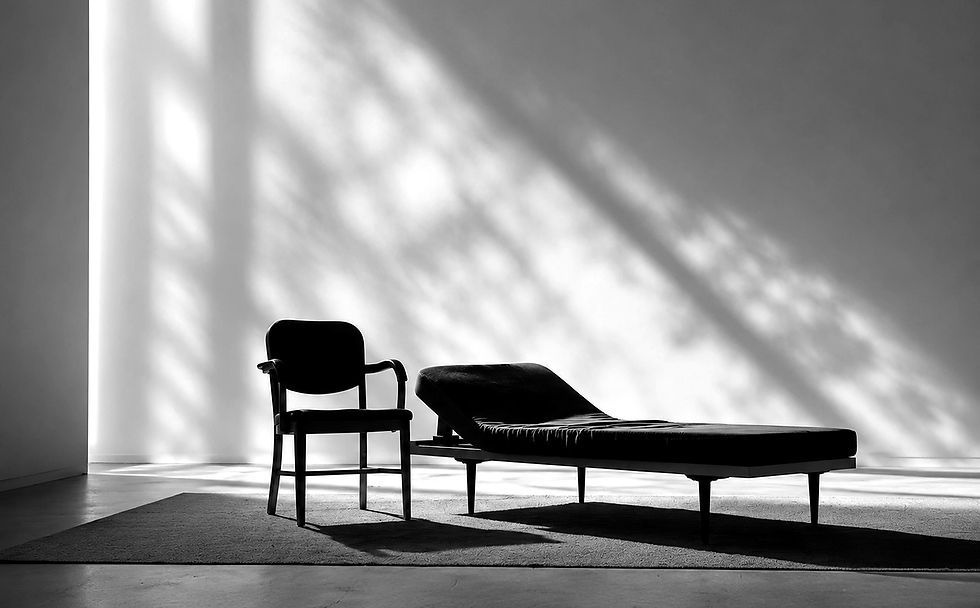
Compared with the more classical image of psychoanalysis, there is a greater flexibility in form. The analyst may be more active in the conversation, and one may choose to sit in an armchair or lie on the couch, depending on what best serves the work.
The sessions may also take place with different frequency. Some come once a week, others several times a week. The form is determined by what the work requires and by what is possible within the person’s particular life situation.
WHAT CAN PSYCHOANALYSIS LEAD TO?
Psychoanalysis offers time, continuity, and a possibility of approaching what otherwise easily remains repeated, wordless, or difficult to understand. Over time, what has previously been experienced only as fate, necessity, or personal deficiency may begin to appear in another way.
When it becomes possible to understand something of what has governed life from the hidden places, the relation to it can also change. What previously returned as compulsion, blockage, or self-loss may begin to acquire language, meaning, and direction.
This opens toward greater inner freedom, deeper self-knowledge, and a more conscious relation to oneself, to others, and to life itself.
WHAT DIFFERS PSYCHOANALYSIS FROM OTHER FORMS OF TREATMENT AND DEVELOPMENT?
One can, in simplified terms, divide the field into three different traditions: psychology, psychiatry, and psychoanalysis.
Psychologists and licensed psychotherapists work within the regulated field of healthcare. Their work often concerns assessing, treating, and alleviating psychological suffering. This may involve diagnosis, a treatment plan, conversation, exercises, and different forms of psychotherapeutic work. The psychiatrist is a physician and works with the medical side of psychological suffering, for example diagnostics, medication, and psychiatric assessments.
Psychoanalysis proceeds from another understanding of the human being. It may also begin in suffering, anxiety, low mood, relational difficulties, or recurring life patterns. But its aim is not only to reduce symptoms. Analysis seeks what lies behind the suffering: the unconscious conflicts, desires, defences, attachments, and repetitions that shape a person’s life.
The person who enters psychoanalysis is traditionally called an analysand. This marks a different position. The analysand is not a patient to be cured by an expert, but someone who, together with the analyst, investigates her own life, her own suffering, and her own possibilities.
Psychoanalysis therefore asks not only what is wrong, but what something means. It asks not only how suffering can be reduced, but what the person wants, what she defends herself against, where her desire has become bound, and what life may still become possible.
In this way, psychoanalysis moves within a clinical, existential, and philosophical register. It is work with the unconscious, but also with freedom, responsibility, will, and life direction. One could call it a philosophy of the soul, but also concrete work in reclaiming the possibility of living more in accordance with one’s own will.